
Automotive V ehicle and Component Testing
Advancements in Automotive Testing Technology Driven by technological progress, automotive testing has evolved beyond traditional methods. The integration of cross-disciplinary innovations has catalyzed breakthroughs in testing equipment and methodologies.
DYNA-MESS (Germany) Customized Testing Solutions Our specialized engineering team delivers tailor-made testing systems for complete vehicles and components through:
- Conceptualization → Design → Manufacturing → Installation
- Custom-engineered testing solutions aligned with precise client requirements
ROACTERE Series Robotic Door Cycling Endurance Test Systems
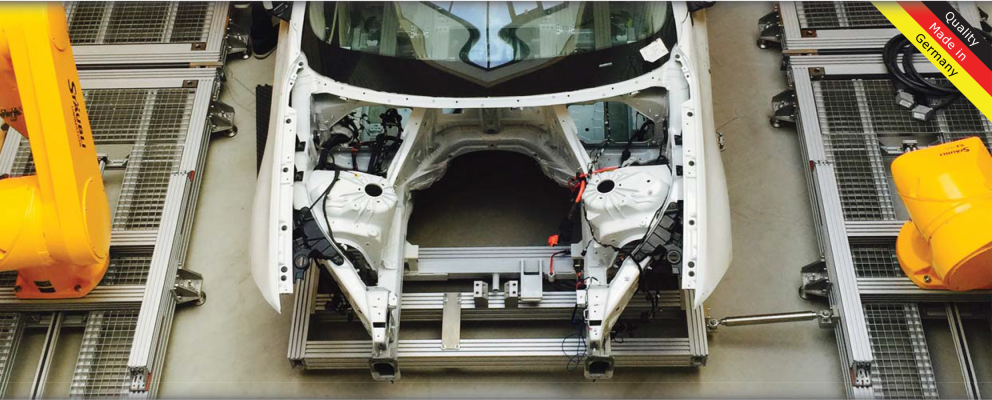
ICDT Automotive Interior Door Durability Test
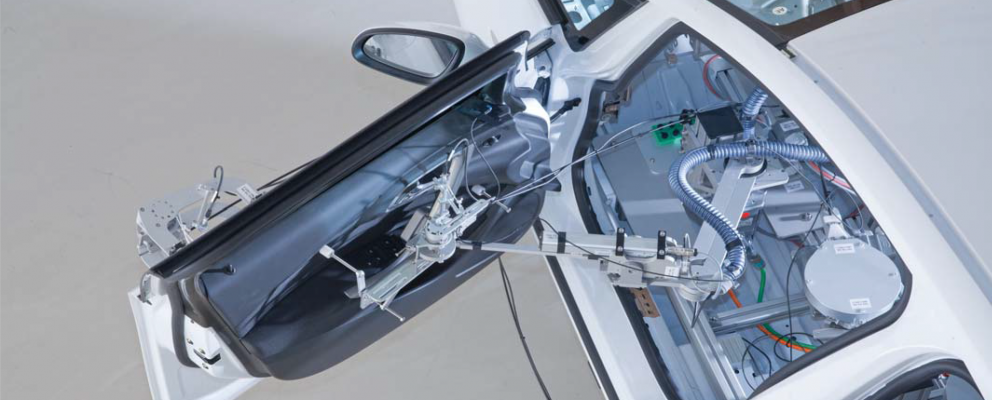
TME Door Closing Energy Test

DMA (Dynamic Mechanical Analysis) is a test platform with high measurement accuracy, stability, and independence from operator influence. It is designed to evaluate the closing and opening processes of vehicle doors and panels. The system operates simply and automatically records and monitors during durability tests. Measurement data provide detailed reports on the test object’s behavior under test conditions throughout its lifecycle, accurately measuring closing force, lock position, and energy.
Static measurement:
-
Locking torque can be measured via an anti‑vibration linear axis
-
Relationship curves between opening and closing angles
Dynamic measurement:
-
Determination of minimum closing energy by applying a specific energy to the door unit; the door follows a definable speed profile until the energy limit is reached, then disengages from the motor and freely engages into the lock.
rMot, lMot series Door and Lid Test Systems
HiL Window Lifter Test System
Lock‑Cylinder Test Bench
The lock‑cylinder test bench is used to determine and test the effects of linear forces and torque on vehicle keys and locks. The robust test system consists of standardized components, making it easy to install and maintain. The load capacity of the test unit has been significantly expanded by Karing.
EDMT Electric Motor Test System
Using Karing’s unique platform for testing electric drive motors enables testing of simple electric motors and their electronic control units. Motor specifications can be verified, and motor testing can be performed under operational conditions. The use of a mechanical loading system and cooling conditioning system allows complete simulation of vehicle conditions without the need for an additional environmental chamber.
Spoiler Test Bench
Using this spoiler test bench, all types and sizes of rear‑window spoilers and rear spoilers can be subjected to various test designs. The specimen is tested via two linear actuators capable of simulating both tensile and compressive forces. The actuators also allow simulation of different loading conditions. For self‑adjusting spoilers, testing at different positions is possible. The test system can measure applied loads, angles, and displacement paths during the test.
Body‑in‑white Performance Testing
In the modern automotive design and development process, the rationality of body design directly affects vehicle reliability, safety, and dynamic response characteristics. As an elastic system, the vehicle body vibrates under time‑varying external excitation. When the external excitation frequency approaches the system’s natural frequency, resonance occurs. Body‑in‑white performance testing has increasingly gained attention. DYNA‑MESS provides a variety of electric actuators for body‑in‑white testing.
Transmission Gear Testing
The automotive transmission is one of the most critical components in the vehicle’s powertrain system. It is a speed‑changing device that coordinates the engine speed with the actual driving speed of the wheels to optimize engine performance. During vehicle operation, the transmission provides different gear ratios between the engine and the wheels. By shifting gears, the engine can be operated within its optimal power performance range.
Automotive Seat Fatigue Testing Machine
Every seat must undergo rigorous testing before leaving the factory. DYNA‑MESS provides comprehensive solutions for seat testing, including various uniaxial fatigue tests, multiaxial fatigue tests, seat adjustment tests, jounce tests, and stiffness tests.
Automotive Steering System
DYNA‑MESS employs pneumatic fatigue testing machines to conduct axial, tangential, and torsional fatigue tests on steering wheels. Both uniaxial and multiaxial loading tests can be performed, enabling comprehensive analysis of cracks, torsional damage, and permanent deformation to ensure every steering wheel is durable!