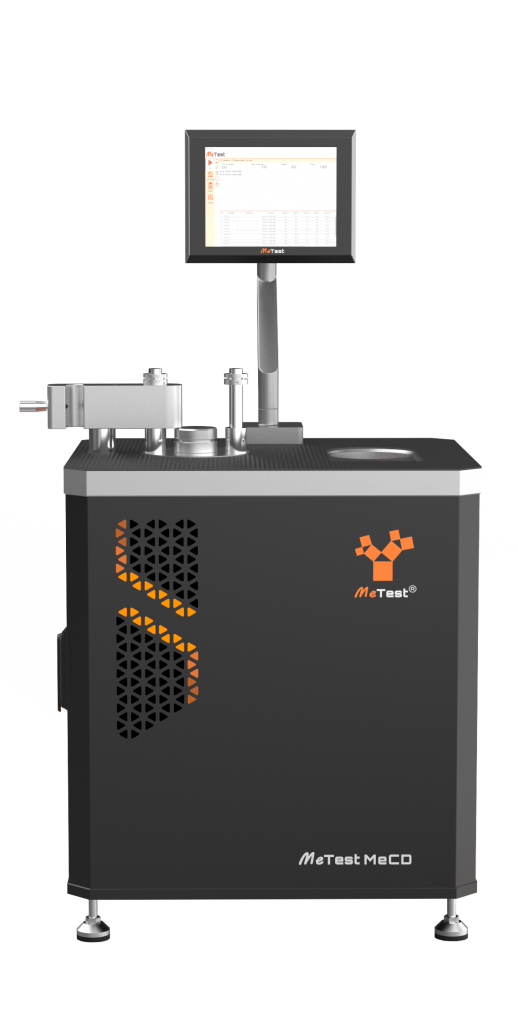
meCD Compaction Density Meter
meCD Compaction Density Meter is an advanced instrument for measuring the density of unvulcanized rubber, effectively applied in quality control of masterbatch and final compounds. It delivers rapid, accurate, and reliable density data, contributing to enhanced production efficiency in industrial settings.
The core of the device is a pneumatically driven piston-cylinder test chamber with precisely calibrated dimensions. The top surface of the test piston forms the base of the chamber. When air pressure is applied to the drive cylinder, the piston moves upward, reducing the internal volume of the test chamber. By measuring the piston displacement via a linear displacement sensor, the initial calibrated volume of the chamber and the remaining volume after a rubber sample is inserted and compressed can be determined, enabling accurate calculation of sample density.
The instrument is specifically designed to determine the density of rubber materials based on the ratio of “sample mass to compressed sample volume.” It is suitable for materials such as raw rubber, carbon black masterbatch, or vulcanizable finished compounds in their unvulcanized state. By measuring the volume change of the sample under compression and combining it with the known sample mass, the material’s density can be calculated.
Standard: ASTM D297.
Features and Advantages
- Ultra-rigid mechanical frame designed with finite element analysis, robust and durable.
- Sleek appearance with low operational noise.
- Short test cycle and high production efficiency, with a full measurement time of 20 seconds per sample.
- Integrated high-precision weighing module ensures high measurement accuracy and short stabilization time.
- User-friendly software interface with guided operation and integrated automatic calibration module.
- Test data can be uploaded to LIMS or MES.
- Equipped with a transparent protective cover, providing clear visibility and a safe testing environment.
- Features an emergency stop button and misuse protection to ensure operational safety.
- Integrated self-diagnostic routines alert operators to system or operational faults.